

On Margaret Preston and the Question of an Australian Art
Australia is a country suspended between two temporalities. Its Indigenous cultures constitute one of the oldest continuous civilisations on the planet, while its nation-state identity, the apparatus of borders and flags and federated governance, is barely two centuries old, hastily assembled in the wake of colonisation. This is not so much a contradiction as a structural condition, and it runs beneath the whole of Australian art history like a fault line. The continent's oldest visual language belongs to Indigenous tradition: rock painting, carving, body art, ground painting, a great deal of it still a living practice rather than an archaeological remnant. European settlement brought with it an entirely different visual project, one preoccupied above all with the documentation of an unfamiliar landscape and the people who already inhabited it. Between these two inheritances sits most of what gets called Australian art, and we have a persistent, almost reflexive habit of sorting artists into one camp or the other, Indigenous or European, as though the categories were self-evidently stable.
They are not. And no single artist exposes that instability more completely than Margaret Preston.
The usual account treats Preston as a flawed pioneer, a woman who did some good and some harm and now awaits a final tally. I want to argue something stranger: that Preston's importance has almost nothing to do with getting the question of Australian art right, and everything to do with making that question impossible to ever put down again. She does not resolve the fault line. She stands directly on top of it, for her entire career, and that is precisely the point.
Preston was born Margaret Rose Macpherson in Adelaide in 1875, and trained under Frederick McCubbin and H. P. Gill, first at the National Gallery of Victoria Art School, then at the Adelaide School of Design. Their realism and impressionism were, at the time, simply what Australian painting was. Preston absorbed the vocabulary fluently. Then she left, and the vocabulary stopped being enough.
In 1904 she left for Europe, and arrived in the middle of an upheaval. Paris, Munich, the Académie Colarossi, all of it moving through Post-Impressionism, Fauvism, and the sudden influence of Japanese woodblock printing, right as those movements were dismantling every inherited assumption about what painting was for. Matisse, van Gogh, Cézanne, Gauguin, Whistler, the wider aesthetic vocabulary of Japan and Asia, all of it entered her practice and stayed there. Her forms loosened, flattened, grew willing to trade fidelity for decorative logic. But here is the part that actually matters: she did not bring a European style home and paste it onto Australian subjects. She came back arguing that Australian art needed to stop rehearsing Europe entirely and start reckoning with itself. In 1920s Australia, that was close to heresy.
That argument crystallises in Flannel Flowers etc (1928), a hand-coloured woodcut in which modernist abstraction and Japanese sensibility are fused almost seamlessly. The flowers are arranged with a tight, near-symmetrical discipline, their forms reduced to something closer to geometry than botany, the whole composition governed by a balance that owes an evident debt to Japanese design principles. The dark, largely unadorned ground performs the same function as negative space in ukiyo-e printmaking, concentrating the eye entirely on the flowers themselves. It is, in its own quiet way, an argument made in visual form, proof that Australian art could be genuinely contemporary and irreducibly local at once, rather than being forced to choose. Preston is already, this early, refusing the binary the rest of the country had not yet noticed it was enforcing.
Her sustained attention to native flora and fauna does related work, and it does it with real stubbornness. Banksias, waratahs, gum blossoms recur across her still lifes and prints with a frequency that reads as conviction rather than habit, a deliberate turning away from the European botanical tradition toward the specific, unglamorous, faintly hostile beauty of the Australian bush. Banksia (1938) is perhaps the clearest instance: a banksia arrangement set against the pale striations of eucalyptus bark, its serrated leaves and spiked flower rendered with a kind of unsentimental precision rather than softened into something more palatable. She is not painting Australia the way a tourist would. In insisting on this vocabulary, Preston was constructing a visual language that later artists could inherit and extend, one that no longer needed to apologise for its own locality.

Margaret Preston, Flannel Flowers, 1928, hand-coloured woodcut, 27.5 x 27.5 cm
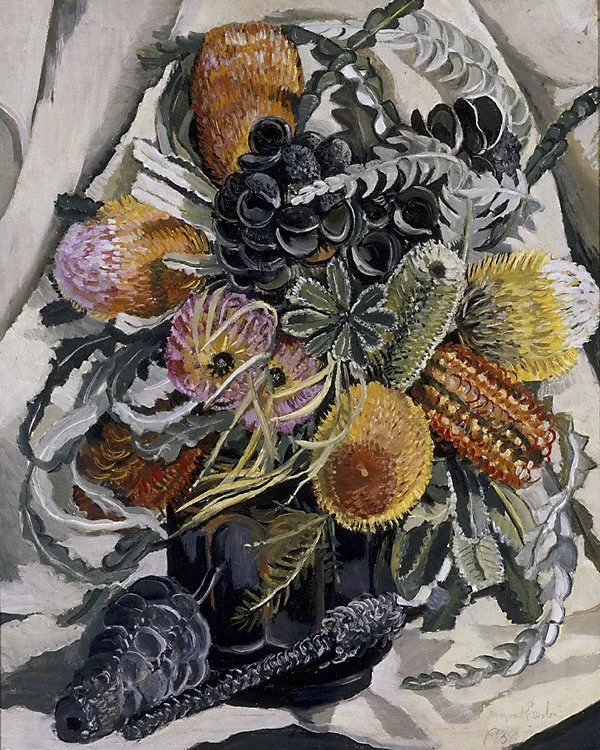
Margaret Preston, Banksia, 1938, oil on canvas, 70.5 x 60.2 x 7.5 cm frame, © Margaret Rose Preston Estate/Copyright Agency
But this is also exactly where the fault line she has been standing on starts to crack open beneath her. From the late 1930s onward, motifs drawn from her sustained study of Indigenous art and artefacts begin surfacing throughout her own practice. Aboriginal Art (1949), a colour stencil, is built almost entirely from this borrowing: concentric circles, dot patterns, an ochre-and-red palette lifted directly from the Australian landscape, all held together by a rhythm indebted as much to Cubism and Fauvism as to the source material itself. Preston wrote and spoke publicly on this too. In a 1930 article she went so far as to call on Australians to "be Aboriginal"(¹), her own words, and about as direct a statement of the borrowing at stake as you could ask for.
That line is precisely what later Aboriginal artists and curators have pushed back against, and I think their pushback matters more here than mine does. The Arrernte and Kalkadoon curator Hetti Perkins has described Preston's use of Aboriginal motifs as "like speaking in a French accent without speaking French"(²), a fluency on the surface without any underlying language. The Aboriginal artist Gordon Bennett, working decades after Preston, took her borrowed motifs and tangled them directly into high modernist grids in his Home Décor series, forcing the question of ownership back onto the work itself rather than leaving it as subtext(³). More recently, the Aboriginal artist Tony Albert built an entire exhibition, Conversations with Margaret Preston, out of vintage fabric bearing the kind of appropriated Aboriginal imagery Preston's advocacy helped popularise, what he calls "Aboriginalia"(⁴), treating her legacy as something to be interrogated in the same visual language she used to build it. These are not outside critiques imposed on Preston after the fact. They are Aboriginal artists answering her directly, in the terms she set.
Here is the uncomfortable part, and I do not think it should be smoothed over. The conventional art-historical narrative, particularly in the years following her death in 1963, casts her as a champion of both Australian nationalism and Indigenous art, a figure who pulled Aboriginal design into the centre of a national visual vocabulary. A more contemporary reading looks at the identical body of work and sees a European woman appropriating sacred and culturally specific imagery from a people who were, at the very moment she was painting, being actively dispossessed. Both of these are true. At the same time. Neither one cancels the other out, and anyone telling you it does is offering you a cleaner story than the facts actually support.
Preston was, before anything else, a modernist, which meant her instinct was always toward abstract formal values, pattern, rhythm, colour, composition, frequently at the expense of the social and spiritual weight those forms actually carried for the people who originated them. Certain of the images she borrowed emerge from religious and ceremonial contexts in which the symbolism is not decorative at all, but load-bearing, structurally essential to meaning rather than incidental to it. To treat such imagery as raw material for visual interest, however admiring the intention behind it, constitutes its own quiet erasure. Her legacy is accordingly split down the middle. On one hand, she forced Indigenous design into the centre of a national conversation from which it had previously been excluded, and opened a door that other artists subsequently walked through. On the other, the manner in which she herself walked through that door reflects an understanding that was, by her own evident admission, comparatively shallow, dressed in the language of reverence.
I do not read that tension as a flaw in the account of her career. I think it is the account of her career. Preston's real contribution was never that she solved the problem of what Australian art is, or could be. It is that she made the question impossible to avoid, that she forced the matter of whose land, whose imagery, whose authority to use it, into a conversation Australian art is still having, with considerably more honesty than she herself ever managed to bring to it. Nearly a century later, we still have not answered her question. We have just gotten more careful about how we ask it.
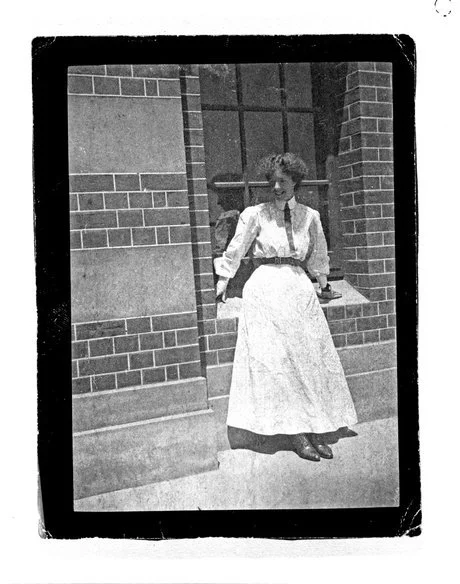
Margaret Preston in her Adelaide studio, c. 1909. Source: State Library of South Australia.

Margaret Preston in Paris, c. 1905. Source: National Gallery of Australia.
Footnotes
Margaret Preston, "The Application of Aboriginal Designs," Art in Australia, 3rd series, no. 31, March 1930.
Hetti Perkins, quoted in Alexa Moses, "Shadow Cast Over a Painter's Legacy," Sydney Morning Herald, 25 July 2005, p. 11.
Gordon Bennett, Home Décor (after Margaret Preston), Sutton Gallery Project Space, Melbourne, 2010.
Tony Albert, Conversations with Margaret Preston, Sullivan+Strumpf, Sydney, 2020–21.