

On Margaret Preston and the Question of an Australian Art
Australia is a strange place to try to invent a national art. By the time Margaret Preston began seriously asking what Australian art should look like, the Commonwealth itself was barely two decades old. The continent was another matter. Aboriginal and Torres Strait Islander peoples belonged to hundreds of distinct nations, with artistic traditions embedded in Country, kinship, Law, ceremony and ancestral knowledge that long predated the colonial state. British settlement brought with it a very different visual inheritance. European conventions of perspective, naturalism and landscape painting organised land as something viewed. Foreground gave way to middle distance, forms diminished as they receded, and the position of the observing eye determined how space was constructed. By the late nineteenth century, Australian artists were already trying to make this inherited language answer to a landscape that did not look much like Europe. Preston inherited that problem. What makes her important is how far she was willing to push it.
Before Preston, Australian artists had already begun asking what a national art might look like. In the late nineteenth century, painters now associated with Australian Impressionism, including Tom Roberts, Frederick McCubbin and Arthur Streeton, turned towards the particular light, heat and landscape of Australia. Their work helped make the bush central to an emerging national identity, even while their approach to landscape remained grounded in European painting traditions.¹ Arthur Streeton's Golden Summer, Eaglemont (1889) (Figure 1) makes the distinction visible. The painting is unmistakably Australian. Dry golden grass, blue distance and bleached summer light replace the green pastoral landscape associated with Britain. Yet the painting remains legible within a European-derived idea of landscape. We stand before the scene and look into it. The foreground opens onto undulating pasture, the land recedes towards distant blue hills, and atmospheric colour creates depth. Streeton helped make the Australian landscape look distinctly Australian, but the fundamental relationship between viewer and view remained familiar.
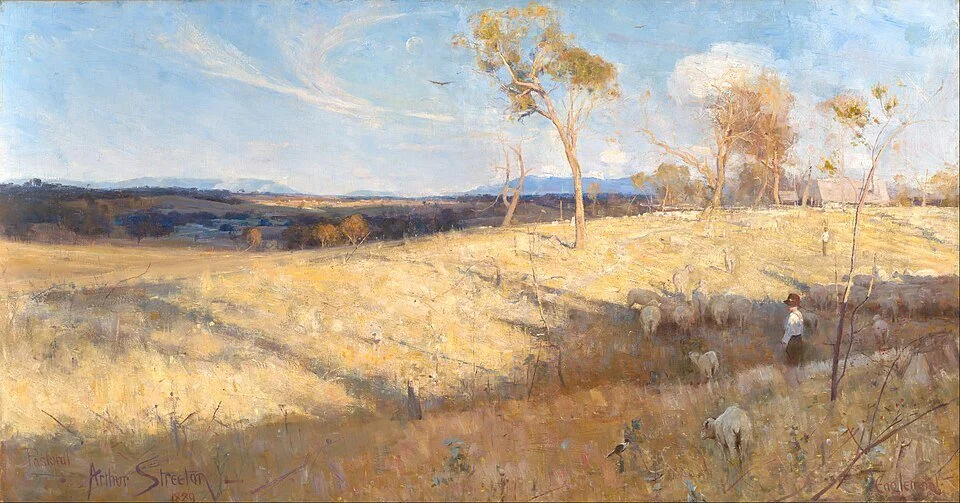
Figure 1, Arthur Streeton, Golden Summer, Eaglemont, 1889, oil on canvas, 81.3 cm × 152.6 cm, National Gallery of Australia.
Preston's problem, then, was not simply how to make Australian art look more Australian. Streeton's generation had already begun doing that. Her question was whether the visual conventions through which Australia was being seen needed to change too.
This distinction matters because "landscape" is not a culturally neutral category. A British viewer accustomed to landscape as a view, with horizon, recession and atmosphere organised according to the position of an observing eye, might not even have recognised an Indigenous representation concerned with the same Country as a landscape. That failure of recognition tells us more about the limits of the European category than it does about Indigenous art. There is no single Aboriginal visual language, just as there is no single European one. Across different First Nations traditions, however, representations of Country can encode relationships between particular places, ancestral narratives, pathways, Law, ceremony, kinship and knowledge rather than simply reproducing the optical appearance of a place.² Two artists might therefore be concerned with the same land while making images that operate according to profoundly different ideas of what land is, what an image is, and what representing Country might mean.
Preston's practice becomes fascinating precisely at this intersection. She did not simply want Australian artists to paint more recognisably Australian things. The Australian Impressionists had already demonstrated the possibilities of that. She wanted to reconsider the visual language through which Australia itself was represented. Her search took her through European modernism, Japanese printmaking, Chinese art, Australian flora and landscape, and eventually towards Indigenous art. The result was never some pure Australian style untouched by outside influence. Quite the opposite. Preston's modernism was built through cultural encounters. The interesting question is what happened when the sources she drew upon ceased to be simply international artistic influences and became the cultural traditions of the First Peoples of the country whose national identity she was trying to define.
Preston first had to learn Europe before she could argue with it. Born Margaret Rose McPherson in Adelaide in 1875, she trained in Australia before travelling to Europe in 1904 and again from 1912 (Figure 2). Her time abroad exposed her to Post-Impressionism and contemporary decorative art, while Japanese prints became particularly important to her understanding of composition and printmaking.³ This was a moment when European artists themselves were questioning naturalism, perspective and academic hierarchies. Space flattened. Pattern acquired new authority. Japanese prints had already demonstrated that an image did not need Renaissance perspective to create sophisticated spatial relationships. African, Oceanic and other non-European objects were also being collected and studied by avant-garde artists, frequently through the reductive colonial category of "primitive art". European modernism had discovered that one way to escape its own conventions was to look somewhere else.
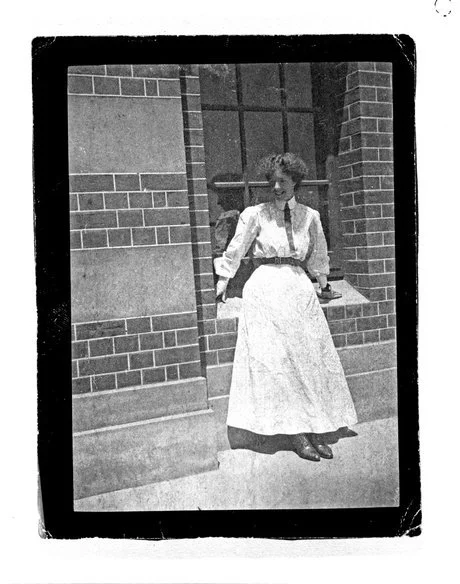
Figure 2, Photograph of Margaret Preston in Paris, c. 1905, sourced from the National Gallery of Australia.
Preston absorbed that lesson, but increasingly turned the search back towards Australia. In 1925 she explained that, wanting to rid herself of the "mannerisms of a country other than my own", she had turned towards Aboriginal art, which she believed could provide a foundation for a national Australian art.⁴ It is a remarkable statement because it contains the ambition and the complication of her project almost simultaneously. Preston understood that Australia possessed artistic histories independent of Europe. Yet she also imagined those histories as something from which a modern national culture could be built. Indigenous art was being asked, at least in part, to solve a problem of settler identity.
Before that problem fully entered her work, however, there were the flowers.
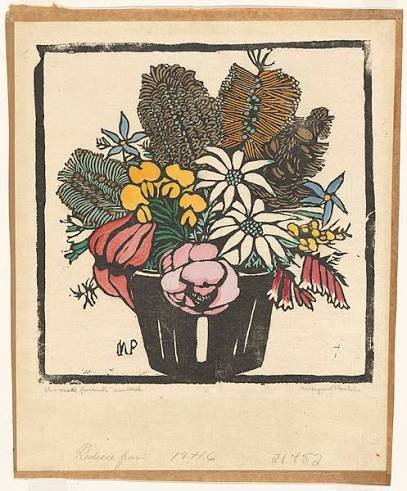
Figure 3, Margaret Preston, Flannel Flowers, 1928, hand-coloured woodcut, 27.5 x 27.5 cm, National Gallery of Australia.
In Flannel Flowers (1928), Preston takes one of the most conventional subjects in Western art, a vase of flowers, and makes it behave rather strangely. The hand coloured woodcut is tightly compressed. Native flowers crowd against one another rather than opening naturally into space. Thick black contours separate petals, stems and leaves, while areas of colour sit almost directly on the surface of the image. The dark vase anchors the composition but offers little illusion of volume. Even the irregularities of the printed line remain visible, reminding us that this is a constructed image rather than a transparent window onto a scene.⁵
The flowers themselves are recognisable, but Preston is not particularly interested in their botanical individuality. Flannel flowers, banksia and Sturt's desert pea become repeated units of shape, texture and colour.⁶ Natural irregularity is disciplined into design. This is where Preston's knowledge of Japanese printmaking becomes especially productive. Space no longer has to behave according to European illusionism. Black line, negative space, pattern and asymmetry can organise the picture instead.
This is more than a stylistic exercise. Preston is testing how Australian subject matter might generate a modern visual language. A botanical illustrator records a flower. Preston turns one into a visual system. The Australian plant is not merely inserted into an existing European picture. Its forms are flattened, exaggerated and reorganised until they begin determining the structure of the image itself. Her international influences therefore do not make the work less Australian. They give her the formal tools with which to make Australian things behave differently.
And flowers were relatively easy.
No one owns a banksia. An Indigenous design is another matter.
That distinction is central to what happens next. A plant can become national imagery without carrying the same questions of cultural authority as a design associated with particular people, places, ceremonies or systems of knowledge. Preston did not initially distinguish between these categories in the way a contemporary curator would. Native flora and Indigenous art could both appear to offer alternatives to imported European convention. But one belonged to the environment she was representing. The other belonged to living cultures whose relationships to the continent preceded the nation Preston wanted to give an artistic identity.
Her engagement with Indigenous art nevertheless became increasingly serious. Living at Berowra on the Hawkesbury River from 1932 brought Preston into proximity with Aboriginal rock engravings. She developed a friendship with Fred McCarthy, curator of anthropology at the Australian Museum, and Preston and her husband joined the Anthropological Society of New South Wales. In 1940 they travelled through Queensland, Western Australia and the Northern Territory, visiting rock art sites.⁷ The way she learned matters. Her encounters took place both in Country and through anthropology, one of the principal settler institutions through which Indigenous objects, practices and knowledge were collected, classified and interpreted during this period.
Her understanding also changed. Kirsty Grant's study of Preston's Shoalhaven Gorge, New South Wales notes that her early appropriation occurred with limited understanding of the cultural and social significance of Indigenous imagery, but that her knowledge deepened considerably over time.⁸ This prevents an easy caricature of Preston as an artist casually collecting motifs because they looked exotic or modern. She studied, travelled, lectured and wrote about Aboriginal art. In 1941 she described it as "a great art" and "the foundation of a national culture for this country".⁹
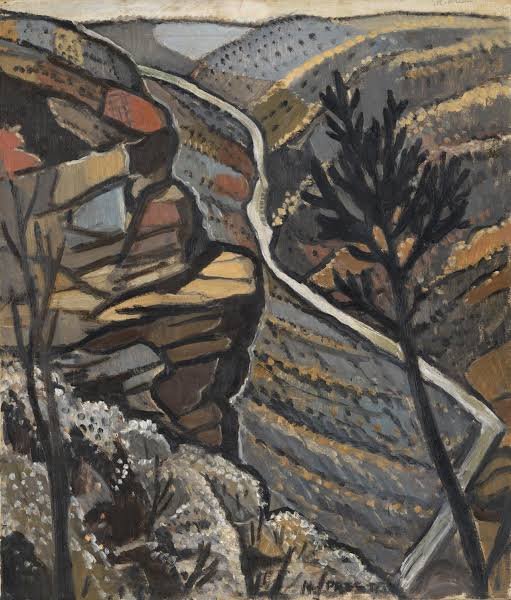
Figure 4, Margaret Preston, Shoalhaven Gorge, New South Wales, 1940-41, oil and gouache on canvas, 53.7 × 45.8 cm, National Gallery of Victoria.
The conviction was significant. At a time when Aboriginal cultural production was frequently positioned within anthropology rather than granted equal status within Australian fine art institutions, Preston insisted on its artistic importance. But listen carefully to the second half of her proposition. Aboriginal art becomes the foundation for "a national culture". Preston recognises a culture that predates Australia and then asks what it can provide for Australian national identity. The respect is real. So is the translation.
Shoalhaven Gorge, New South Wales (1940 to 1941) (Figure 4) is where that translation becomes visible.
At first glance, we are still looking at a landscape. White water winds through the gorge, hills rise around it, and vegetation punctuates the terrain. But almost everything expected of the conventional European landscape has begun to misbehave. Depth is compressed. The hills become broad shapes outlined in black rather than forms softened by atmospheric recession. Ochres, browns and black replace naturalistic colour. Dots and parallel marks travel across the surface. The pale river does not convincingly disappear into the distance. It snakes through the composition like a graphic sign.¹⁰
Compare this with Streeton's Golden Summer. Streeton's eye carries us into the landscape. Preston keeps pushing us back towards the surface.
That difference is the heart of the painting.
The NGV identifies Preston's ochre and black palette, patterning, dots, parallel lines, strong outlines and flattening of pictorial space as features developed through her study of Indigenous art.¹¹ But simply identifying their source does not tell us what those features actually do. They destabilise the inherited settler landscape. Perspective becomes less authoritative. Pattern competes with illusion. The land is no longer presented as a distant view that submits easily to the spectator's eye.
Preston has not stopped painting landscape. She has started questioning some of the visual assumptions that made European landscape painting look natural in the first place.
This is a more radical intervention than simply adding Indigenous motifs to an otherwise European picture. Australian Impressionists had transformed the palette and atmosphere of settler landscape painting, making Australian heat, light and vegetation central to national imagery. Preston pushes further. What she understood from Indigenous art gave her tools with which to disturb the pictorial structure itself. Shoalhaven Gorge asks whether Australia might require not simply different subjects, but different ways of organising vision.
Yet abandoning European perspective does not automatically produce an Indigenous way of seeing.
This is the hinge of Preston's practice. Shoalhaven Gorge remains unmistakably hers. It is a modernist synthesis produced by a European trained settler artist who was already drawing from Japanese and Chinese art and who now selected and reorganised formal qualities she encountered in Indigenous traditions. Preston does not reproduce an Indigenous artwork, nor does she somehow step outside her own cultural formation. She translates what she has learned through it.
And translation changes what it carries.
This becomes particularly important when we consider what the European category of "landscape" leaves out. Country is not simply another word for landscape. Across First Nations cultures, Country can encompass land, waters and skies alongside ancestral knowledge, living beings, spirituality, Law, kinship and identity. An image concerned with Country may therefore perform work that cannot be reduced to depicting how a place looks. This does not mean that all Indigenous art functions identically. It means that a dot, line, palette or compositional structure cannot necessarily be separated from the cultural relationships through which it carries meaning.
Preston's modernist instinct, however, was profoundly synthetic. Japanese prints, Chinese art, European modernism, native flora and Indigenous art could all be studied, abstracted and brought into relation within her own practice. During the 1940s, this increasingly affected not only her imagery but her materials. She experimented with the rough side of masonite, monotype and stencil. Aboriginal motifs and symbols, together with colours derived from bark painting, became increasingly prominent in her prints.¹² Indigenous art was changing her palette, surface, spatial organisation and process.
This is where the implications of Preston's project become most interesting. Her sources did not all occupy equivalent historical positions. Learning from Japanese composition or European Post Impressionism was not culturally identical to incorporating forms derived from the art of peoples living under the continuing consequences of colonisation. Indigenous cultural forms belonged to communities whose lands had been appropriated in the creation of the Australian nation itself. Using those forms to help construct a national settler aesthetic therefore carried implications beyond formal experimentation.
That does not mean Preston's admiration was false, nor does it require us to make her either hero or villain. Admiration and appropriation can occupy the same practice. Preston could recognise Aboriginal art as sophisticated and fundamental to the continent while still encountering it through modernist and anthropological frameworks that allowed particular elements to become available for her own use. This contradiction was embedded in her nationalism. She wanted Australian art to stop depending upon Europe. Indigenous art offered her artistic histories unquestionably rooted in this continent. The very thing that made those histories so important to her was also what made their incorporation into settler nationalism so complicated.
Later First Nations artists allow us to see that complication from another position. In Conversations with Preston: Fennel Flowers and Sturt's Desert Pea (2020) (fig. 4), Tony Albert returns directly to Preston's Flannel Flowers (1928). He retains the recognisable structure of her floral composition, but reconstructs it using vintage fabric from his collection of “Aboriginalia”, his term for the mass produced objects and imagery that stereotyped Aboriginal people and culture within Australian domestic life.¹³ Even the flowers shift. Preston's white flannel flowers become Albert's yellow fennel flowers. The image remains recognisable, but it is no longer entirely hers.
The reversal is pointed. Preston had looked towards Indigenous art while searching for an Australian visual language. Nearly a century later, an Indigenous artist takes Preston's visual language and makes it his material. Albert is not simply condemning her. He has described the project as a conversation rather than an accusation, acknowledging Preston's genuine interest in Indigenous art while questioning what happened when Indigenous imagery entered the wider visual culture of settler Australia.¹³ Albert therefore shifts the direction of interpretation. Indigenous culture is no longer positioned simply as material to be studied, borrowed or translated. An Indigenous artist is now looking back at Preston, rearranging her imagery and taking an active role in how that history is understood.
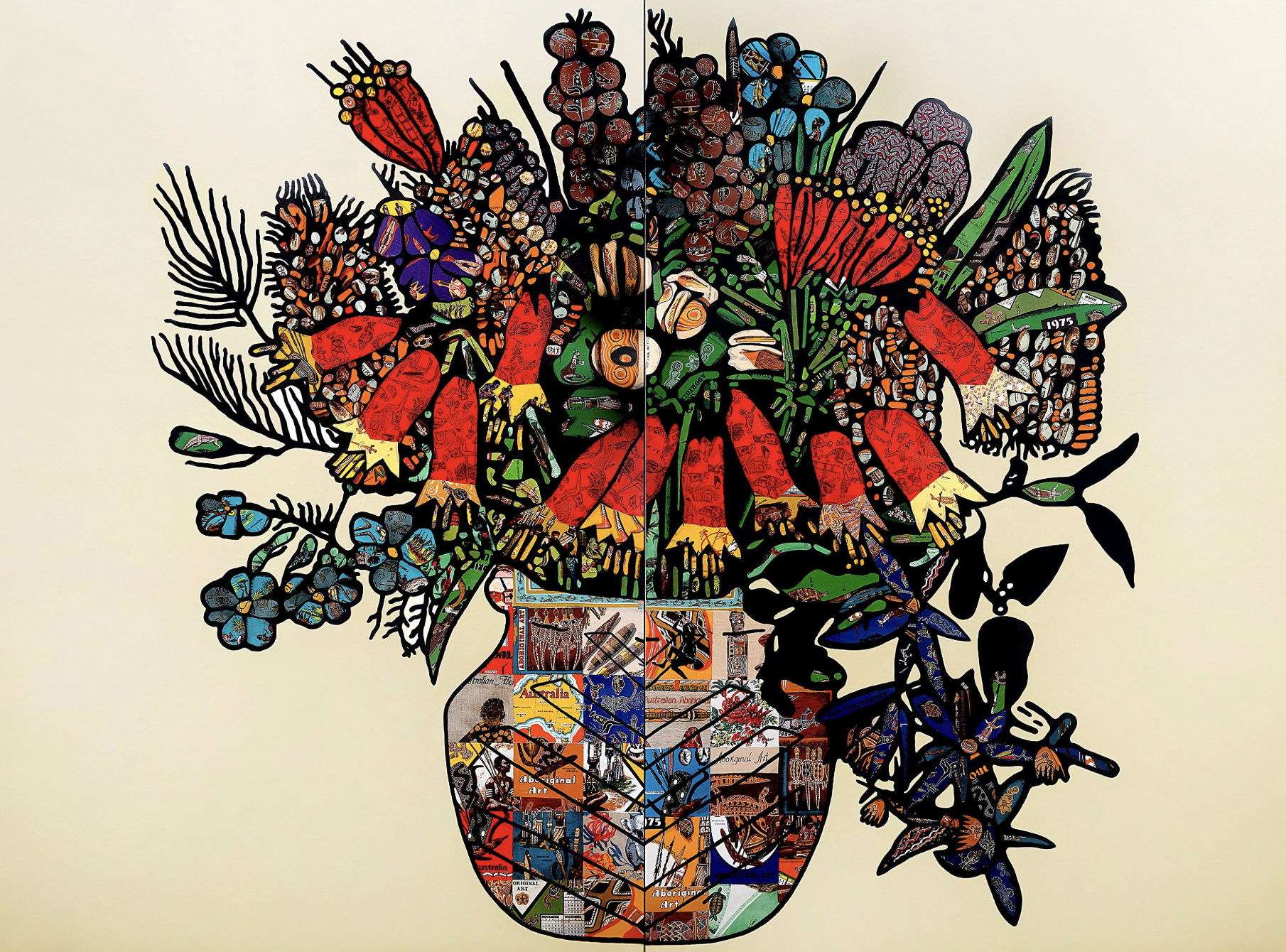
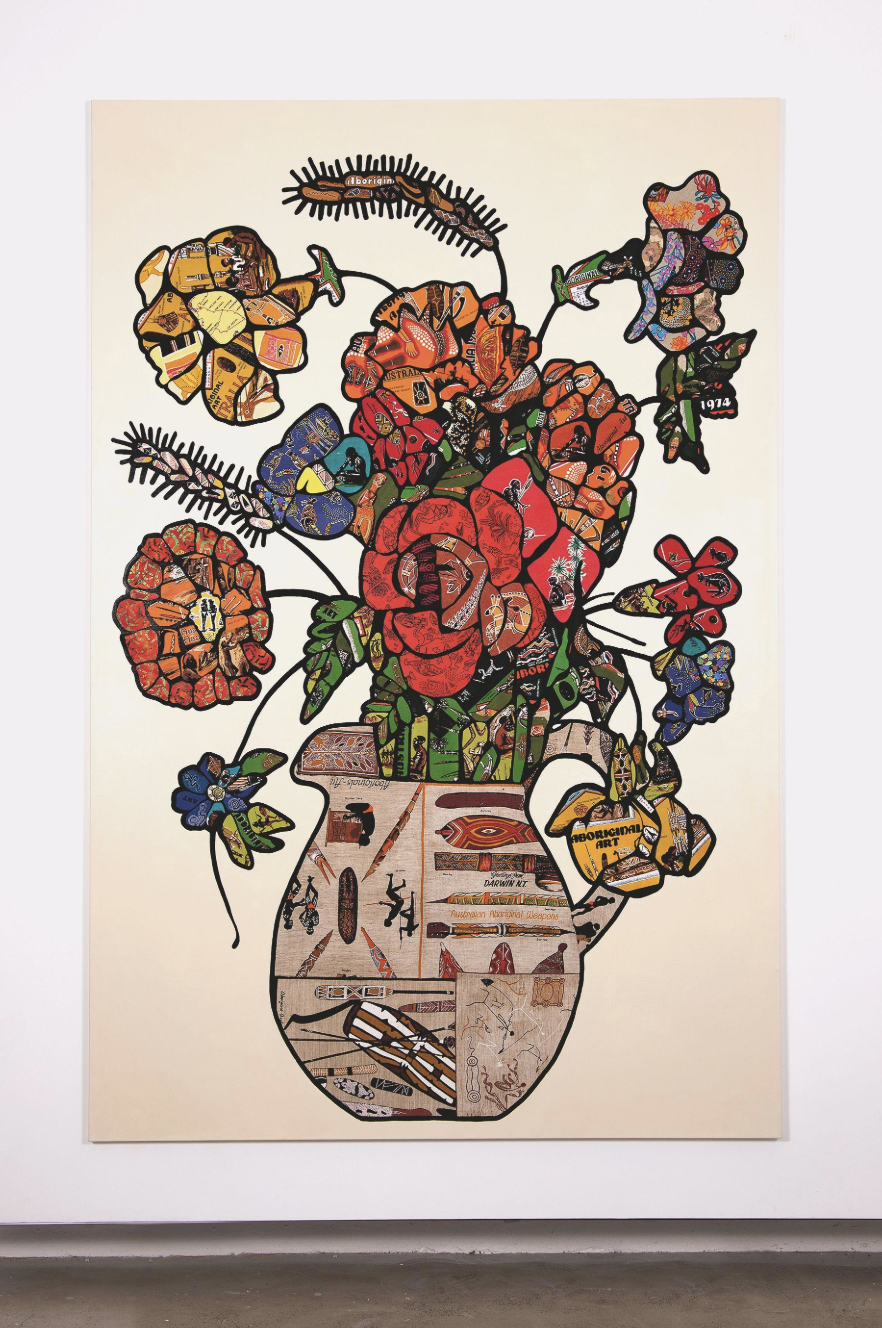
Figure 5, Tony Albert, Conversations with Preston: Fennel Flowers and Sturt’s Desert Pea, 2020, acrylic and vintage appropriated fabric on Arches paper, 62 × 57 cm, courtesy of the artist.
The distinction between settler landscape and Indigenous representations of Country becomes especially clear in the National Gallery of Australia's Belonging display, which placed Australian Impressionist landscapes alongside Papunya paintings from the 1970s.¹⁴ The comparison is contemporary, not historical. Preston never encountered the Western Desert acrylic movement, which developed after her lifetime. But the juxtaposition makes a powerful point. Streeton's landscape presents land as a view. The Papunya works can map relationships between Country, Law, ancestral narratives and ceremony. Both concern place, but they ask an image of place to do very different things.
The difference is not simply how the land looks. It is what the land means, and what an artwork is expected to carry.
This distinction helps us understand Preston without forcing her into a moral category she cannot neatly occupy. She began within an Australian art world whose dominant landscape tradition was European-derived. Modernism taught her that those conventions were not inevitable. Flannel Flowers shows her using Japanese and modernist principles to transform Australian subject matter into design. Shoalhaven Gorge goes further. Her engagement with Indigenous art helped her disrupt perspective, naturalism and the inherited organisation of settler landscape painting. Yet the further Preston moved from European ways of picturing Australia, the closer she came to cultural languages whose authority was not hers.
That tension remains alive in how Preston is being exhibited now. The NGV's 2026 retrospective places her work in conversation with contemporary First Nations artists responding to her use of Indigenous iconography.¹⁵ This curatorial framing acknowledges something essential to her legacy. Recognising Indigenous art as fundamental to Australian visual culture is not the same thing as possessing the authority to define what that culture means. Preston's significance lies partly in having recognised the first proposition, while her work continues to make us confront the second.
Perhaps the mistake is to imagine Australian art as having a single beginning at all. Indigenous artistic traditions did not end when European painting arrived, just as settler artists did not cease to be Australian because their visual inheritance came from Europe. These histories existed together, unequally and often violently, but neither can be removed from the story of art on this continent.
Preston (Figure 6) was born into that complexity. She was Australian and European-trained, belonging to the place through a settler history distinct from that of its First Peoples. Her engagement with Indigenous art could never erase that distinction, nor should it. What it could do was force her to reconsider the visual assumptions she had inherited and recognise that the history of Australian art extended far beyond them.
Preston's legacy lies somewhere in that recognition. She could not possess the history that preceded her, but she could allow it to change her. And while looking towards a history far older than her own, she made work that changed the history still being written.
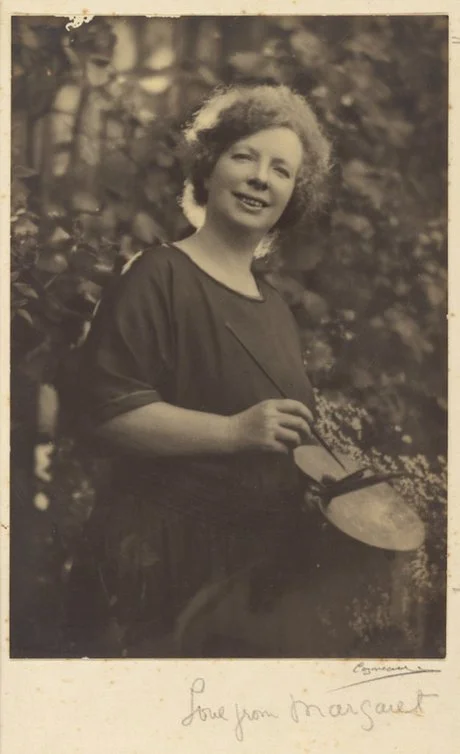
Figure 6, Portrait of Margaret Preston, c. 1924, by Harold Cazneaux, Preston archive, Art Gallery of New South Wales.
Footnotes
1. National Gallery of Australia, “Australian Impressionism,” exhibition essay, accessed August 19, 2026. The National Gallery situates Arthur Streeton, Tom Roberts, Charles Conder and their contemporaries within an Australian artistic culture that sought to represent the distinctive landscape, light and atmosphere of Australia while remaining closely connected to British and European artistic traditions. National Gallery of Australia
2. National Gallery of Australia, “Belonging: Stories of Australian Art,” April 24, 2020. The exhibition brought First Nations and non Indigenous works into dialogue, including Australian Impressionist landscapes and paintings made by senior Aboriginal ceremony men at Papunya, to examine differing relationships to landscape, Country, Law and place. National Gallery of Australia
3. National Gallery of Australia, “Margaret Preston,” Making it Modern; National Gallery of Australia, “The Prints of Margaret Preston.” These sources document Preston’s European travel, her engagement with modernism and her sustained interest in Japanese printmaking and design.
4. Margaret Preston, “The Indigenous Art of Australia,” Art in Australia, 3rd ser., no. 13 (March 1925). Preston argued that, in seeking to rid her work of the “mannerisms of a country other than my own,” she had turned towards Aboriginal art as a potential foundation for an Australian national art.
5. Margaret Preston, Flannel Flowers, 1928, hand coloured woodcut, printed in black ink from one block, Centre for Australian Art, Australian Prints + Printmaking.
6. Centre for Australian Art, Australian Prints + Printmaking, “Flannel Flowers,” 1928. The collection record identifies flannel flowers, banksia and Sturt’s desert pea within Preston’s composition.
7. Kirsty Grant, “Margaret Preston’s Shoalhaven Gorge, New South Wales,” Art Bulletin of Victoria 48, National Gallery of Victoria. Grant documents Preston’s years at Berowra, her friendship with Australian Museum anthropologist Frederick McCarthy, her membership of the Anthropological Society of New South Wales and her 1940 travels to view Aboriginal rock art.
8. Grant, “Margaret Preston’s Shoalhaven Gorge, New South Wales.” Grant traces the development of Preston’s engagement with Aboriginal art, noting that her earlier appropriation occurred with limited understanding of its cultural and social significance and that her knowledge became considerably more sophisticated over time.
9. Margaret Preston, “Aboriginal Art,” Art in Australia (June 1941), quoted in Kirsty Grant, “Margaret Preston’s Shoalhaven Gorge, New South Wales,” Art Bulletin of Victoria 48, National Gallery of Victoria.
10. Margaret Preston, Shoalhaven Gorge, New South Wales, c. 1940–41, oil and gouache on canvas, 53.7 × 45.8 cm, National Gallery of Victoria, Melbourne.
11. Kirsty Grant, “Margaret Preston’s Shoalhaven Gorge, New South Wales,” Art Bulletin of Victoria 48, National Gallery of Victoria. Grant discusses Preston’s use of ochre, brown and black, patterning, dots, parallel lines, strong outlining and flattened pictorial space in relation to her study of Indigenous art.
12. National Gallery of Australia, “The Prints of Margaret Preston.” The National Gallery traces Preston’s experimentation during the 1940s with masonite, monotype and stencil, as well as her increasing use of Aboriginal motifs, symbols and colours informed by her study of bark painting.
13. Tony Albert, Conversations with Preston: Fennel Flowers and Sturt’s Desert Pea, 2020, acrylic and vintage appropriated fabric on Arches paper, 62 × 57 cm. The work belongs to Albert’s Conversations with Margaret Prestonseries, in which he reworks Preston’s imagery using vintage appropriated fabrics associated with his wider investigation of “Aboriginalia” and the circulation of stereotyped representations of Aboriginal people and culture within Australian visual history. Tony Albert
14. National Gallery of Australia, “Belonging: Stories of Australian Art,” April 24, 2020. Under the theme of Country and place, the exhibition placed Australian Impressionist landscapes, including Arthur Streeton’s Golden Summer, Eaglemont(1889), alongside paintings made by senior Aboriginal ceremony men at Papunya in the 1970s. The National Gallery describes the Papunya works as referencing land and Law associated with particular regions and drawing upon ceremonial iconography previously used on ritual objects, body designs and ceremonial ground paintings. National Gallery of Australia
15. National Gallery of Victoria, “Margaret Preston,” Margaret Preston: A Retrospective Exhibition, September 4, 2026–January 31, 2027. The exhibition places Preston’s work in conversation with contemporary First Nations artists responding to her engagement with Indigenous art and iconography.