

What Baldwin Taught Me About Falling Apart
The experience of pain is not a solo phenomenon, despite what the egoistic mind would have us believe. We convince ourselves that what we feel is so abominably abhorrent that there can be no feasible way our fellow counterparts have accomplished such agony and survived it. Perhaps we isolate our experience as a curious way of validating the magnitude of distress. As if to say, indeed, this torture is so deep that there is no reality in which anyone else could fathom my despair.
It is only after we, by hook or crook, endure the pulsing pangs of authentic misery that cause our rib cages to cave in and our stomachs to swell that our eyes are widened to the reality of collective anguish.
By no means am I contending that everyone will appreciate the pain I am narrating. How naive it would be of me to suggest that shared affliction be equal amongst all. Try telling that to a mother who has lost her child, or a war veteran who has returned home with no legs and a lifetime of disturbing memories. In fact, some will move through life asleep to the truth of the extent to which the human body can feel. Some will feel this hurt once, twice, ten times, and for different reasons, acutely personal to them.
And yet we will all experience a degree of pain and suffering that feels so singular to our own existence that we mistake it for a burden meant only for us. Although it may seem unjust that some are asked to endure more than others, there is a quiet peace available in the acceptance of that reality. The shift from “why me?” to “who else?” is not a resignation. It is an opening. It is where isolation ends and connection begins. Whether it is God who determines what we can carry, or simply the arbitrary weight of being alive, I have come to believe it is our duty to move through our lives as they occur, pain included, and to tell stories about them. To gather, to listen, to learn from one another. To normalise saying out loud what our lives actually feel like. There is something radical in that honesty, and something deeply human in the act of bearing witness to it.
It was James Baldwin who first introduced me to the concept of universal suffering. I was home in Northern Denmark for Christmas. The weather of the region mimicked my intense emotional distress; I was frozen cold, my skin was a shade of muted grey, and I had this feeling that I was stuck in a blip of time that would never end. The best part of my day was falling asleep, as difficult as it was to do so, and the worst was waking up, remembering everything I had done to myself the day before and feeling a gush of shame flow from my stomach to my fingertips, knowing full well I would do it all again today. Clutching at straws to understand my life, I found Baldwin: a Black, queer American prophet who wrote about race, love, and exile with such moral precision that his most personal confessions became everyone’s reckoning.
Somewhere between the freezing fjord and the shame of another wasted day, I found the 1971 interview between Baldwin and poet Nikki Giovanni, and I watched it until the sky outside went from black to grey. Two voices, one conversation, but it felt like a mirror split in half. I had never seen anyone speak the way Baldwin speaks — like someone who has seen too much of the world and chosen, against all reasonable judgment, to keep loving it. And in the middle of their exchange about race and responsibility and what it means to survive, he said this:
“You go through life for a long time thinking, no one has ever suffered the way I’ve suffered, my God, my God. And then you realise — you read something, or you hear something — and you realise that your suffering does not isolate you; your suffering is your bridge. Many people have suffered before you, many people are suffering around you and always will, and all you can do is bring, hopefully, a little light into that suffering. Enough light so that the person who is suffering can begin to comprehend his suffering and begin to live with it and begin to change it, change the situation. We don’t change anything; all we can do is invest people with the morale to change it for themselves.” (Baldwin, Soul!, 1971).
I had never previously considered the possibility of loving the world in the midst of a depressive episode. But Baldwin insisted on it. “If you’re willing to live, take your chances on living,” he tells Giovanni, “you become very bright.” There is something clarifying in that framing. To survive pain not as an act of endurance but as an act of intelligence, as though choosing to remain, to feel, to push through the noise of one’s own suffering, is itself a form of becoming. How unlucky and how fortunate at once. And yet Baldwin does not stop at survival. The bridge he describes demands something of us: that we bring light into the suffering of others, enough light that they might begin to comprehend their own pain and find the morale to change it. I felt that as a moral charge. To tell the truth about what it is to struggle, to refuse the performance of ease, and to offer what clarity I have found to those who might need it. The intensity of suffering, it turns out, is not only a wound. It is also a credential.
Giovanni resists this abstraction. Her sensibility is attuned to the ways in which broad philosophical framing can risk flattening what is immediate, embodied, and urgent. She is less interested in the universal than in the conditions that shape it: who is permitted to speak their suffering aloud, and who is not. “Why should a writer be free to write what he wants,” she asks, “when a teacher is not free to teach?” (Soul!, 1971). It is a question about power and permission as much as pain. “If you don’t understand yourself,” she adds, “you don’t understand anybody else.” Baldwin was saying: look outward, your pain is everyone’s pain. Giovanni was saying: not so fast. You have to reckon with the specificity of who you are before you can claim kinship with anyone else’s experience. I felt the truth of that sitting at my computer, looking out at the freezing Mariagerfjord outside my grandparents’ home, thinking that maybe I had avoided the learnings of my own intuition as a young adult and had put myself in positions that would undoubtedly cost me.
And so, having sat with Baldwin’s charge to bring light into suffering, I feel compelled to share something. There is no predicting it, no earning it, no willing it into existence. It simply arrives. One morning, for no discernible reason, the shift happens. Like a scale that has been leaning so negatively for weeks, finally beginning to tip the other way without anyone touching it. The world might actually be in your favour, slightly. Things get easier. Your body steps out of bed with more ease, and you walk to the kitchen and your hips don’t hurt. There are kind text messages on your phone and no drama. Your fridge has leftovers, and the water boiler has stopped dripping. The sun is out, and your boss told you not to come in. Technically, nothing has changed and everything is the same, and yet something in the atmosphere is different. You want to call your mum again. You want to be there for your friends. You are thinking about adopting a dog. You have ambitions. You want to tell people things. It is cosmic and inexplicable and slightly absurd. That is what coming out of a depressive episode feels like. It genuinely feels like four beers and no lunch. Calm and fizzy. And you are jealous, because some people feel this every day. But then we must remember that some people feel far worse, and have been through tenfold worse, and always will. Perspective. I cannot describe it better than a neural pathway eventually breaking through and paving a positive road in the complex navigation system of my brain. Lighter, softer, relaxed and less complicated. Finally. A dribble of hope. How fucking nice.
Baldwin and Giovanni opened an intimate avenue for learning. And what I took from them, above all else, is this: know yourself first, sit with your particular pain, in your particular body, in your particular life, and then tell someone… tell as many people as you can. I was in pain. I will be again. You might too. But we all arrive, eventually, at the same muted collapse, proving that pain, in the end, does not belong to one body alone. And there is comfort in that.
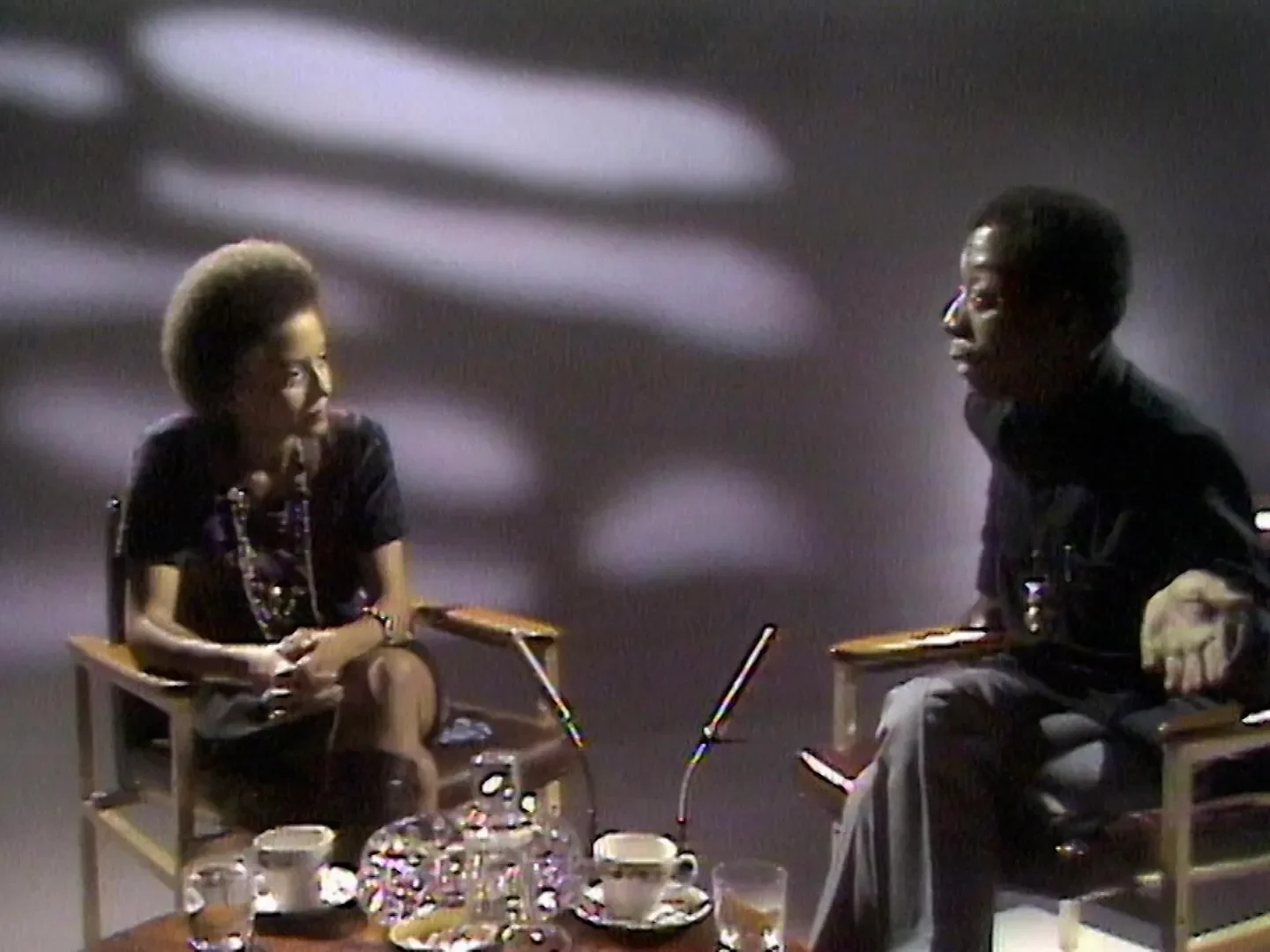
Nikki Giovanni and James Baldwin, Conversation Between Giovanni and Baldwin, SOUL!, recorded in London, 30 November 1971.