

Where Lost Children Go
Hanging Rock is a volcanic formation rising out of bushland near Woodend in Victoria. It has a considerable literary reputation and, in my youth, had a very real capacity to engulf schoolgirls. My father borrowed Peter Weir’s Picnic at Hanging Rock (1975), adapted from Joan Lindsay’s novel, from the DVD store, and we watched it together the night before our planned visit. By morning, the film had had sufficient time to decant into my subconscious. I was about to walk into a landscape I believed could prevent me from leaving.
Pupils from Appleyard College had gone to Hanging Rock for a Valentine’s Day picnic in 1900, accompanied by teachers who warned against exploring its slopes. I understood those arrangements. Adults took you somewhere, told you what you could do, then brought you home. The girls ask permission to explore the base of the rock and promise to return shortly. What frightened me was how little the girls resisted the pull of the rock. As they climb higher through the woodland and among the formations, the outing takes on a hallucinatory quality, and those earlier assurances become irrelevant. Watches stop at noon. Even time seems subject to whatever authority the place possesses. They remove their shoes and lie down around the rocks. We cannot quite tell what is happening to them, but their composure offers little reassurance. When they wake, three continue towards a narrow opening while their companion calls after them in terror. Her fear made sense to me. Their composure was harder to bear. They were being absorbed, in some dreamlike state. I have always thought of nature as a bizarre force with rules of its own. The film gave that belief a frightening possibility. Perhaps you could enter a place where the rules you knew no longer applied, and only realise it once you had stopped questioning them.
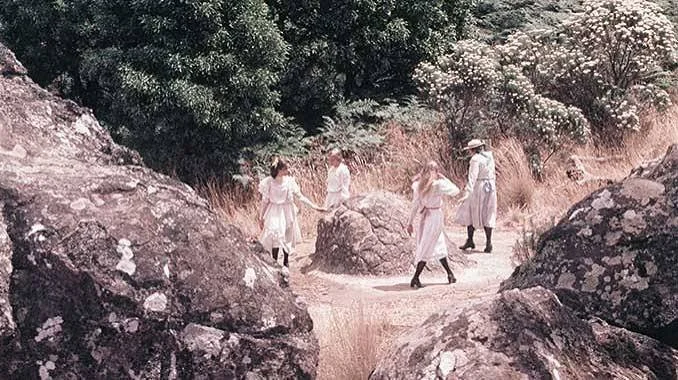
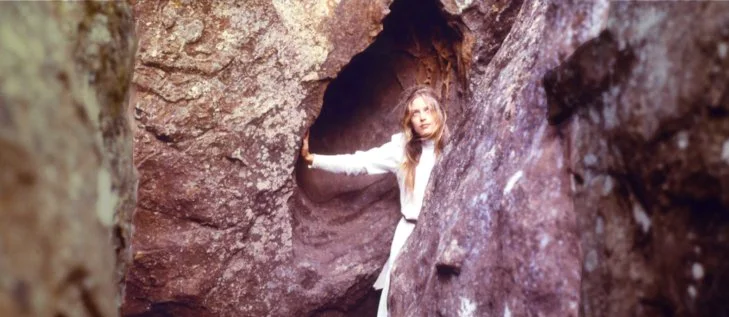
Scenes from Peter Weir’s film, Picnic at Hanging Rock (1975)
One girl was eventually found alive, unable to explain what had happened. The others remained missing. I could find little reassurance in a return that left the disappearance unexplained. Once the landscape seemed capable of taking them, I could not work out what they should have done differently to save themselves. Watching at nine years old, I felt as though the bush and the formations had acquired complete authority over their visitors. How could you protect yourself from a place that seemed capable of deciding where you would go, or whether you would return? Lindsay, the original author, deliberately encouraged uncertainty about whether her story was true.¹ I was quite prepared to believe it. The location existed beyond the screen, and my father intended to take me there.
The next morning, we drove to Hanging Rock for the day. My father reminded me not to stray far from him. I was a curious little Australian girl with plenty of opportunities to explore the bush, and he wanted me to understand how quickly wandering could become confusion, and how getting lost could end in death. After the previous night’s viewing, I required very little persuasion. I was already suspicious of any landscape in which a group of schoolgirls could disappear between lunch and the journey home. He nevertheless saw an opportunity to reinforce the lesson. As we explored, he slipped behind the formations, mimicking the disappearances and calling the girls’ names from out of sight, elongating every syllable. Hearing those names among the rocks gave the film an unbearable proximity. My father knew where he was. I could hear him without being able to see him, which did little to reassure a child who thought the place capable of swallowing people. It is difficult to appreciate a geological formation when you suspect it has an appetite.
The surrounding trees and tangled vegetation offered further concealments, extending my apprehension well beyond the stone. Somewhere close by, my father was enjoying himself. I was discovering how quickly familiar Australian bushland could become a place in which I felt entirely at its mercy. His methods were cruel, but the danger he wanted me to understand was real. My curiosity could carry me further than my ability to find my way back. I grew up loving the textures and scents of the Australian landscape with that warning accompanying the pleasure of exploring it. At Hanging Rock, the practical danger of losing my bearings became entangled with the film’s suggestion that a place could take possession of its visitors. My father eventually stepped back into view. The possibility of being left there stayed with me.
Years later, having never returned to Hanging Rock and with much of its story faded from memory, I found myself standing before Frederick McCubbin’s Lost (1886) in the NGV’s Australian collection at the Ian Potter Centre.² My stomach dropped. The painting depicts a young girl standing alone among eucalypts and tangled undergrowth, one hand raised to her forehead. The vegetation reminded me immediately of the woodland surrounding Hanging Rock. Her hat and pale pinafore recalled the schoolgirls in Weir’s film, and suddenly I could remember my father’s voice calling from somewhere I could not see. He had only been hiding, but my panic had been real, and here it was again, arriving before I had time to reason with it. As I stood looking, I began to recognise the details that had drawn me so abruptly into her predicament.
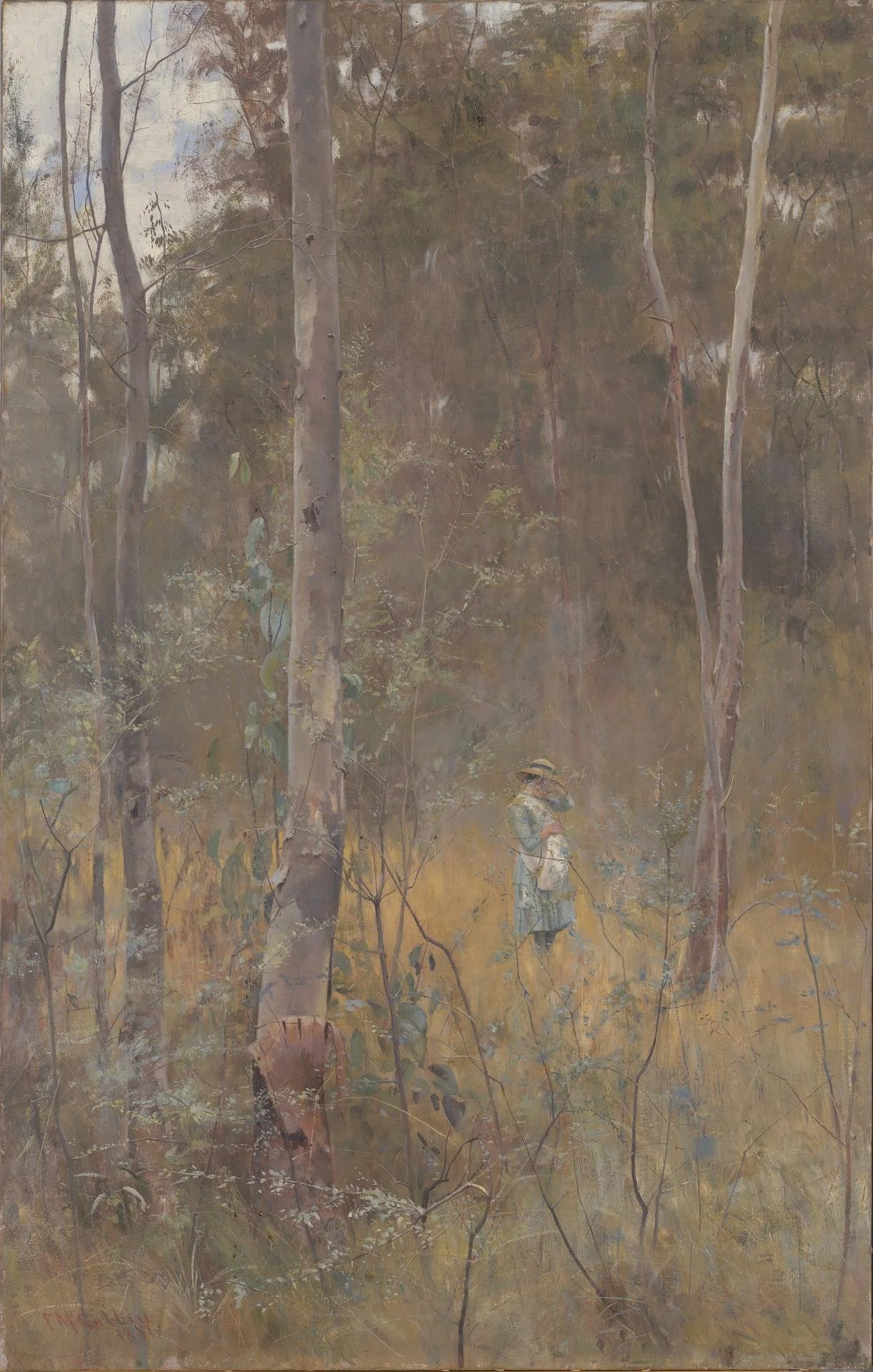
Frederick McCubbin, Lost, 1886, oil on canvas, 115.8 x 73.9 cm, NGV Melbourne
Only afterwards did I discover that the painting’s unsettling premise had a possible basis in fact. McCubbin is thought to have been inspired by Clara Crosbie, a twelve year old who survived three weeks lost in Victorian bushland in 1885.³ At Hanging Rock, I had believed an invented disappearance. Here, having responded instinctively to the image, I found myself reading about a child who had actually endured the predicament I feared. Clara survived, but that knowledge cannot reassure the figure in the painting. McCubbin holds her in the uncertainty before anyone knows how the story will end.
Much of that uncertainty is concentrated in her raised arm. Her hand partly conceals her face, leaving the gesture to carry her apparent distress. She could be shielding her eyes or wiping away tears. I read anguish in it, recognising the instinct to bring a hand to your face when looking around has failed to make things clearer. Her other hand holds pale fabric close to her body, as though she is gathering herself into the little space she occupies. Scale and proportion make that space painfully small. Positioned low in the tall canvas, she stands beneath trunks that extend far above her. The pale pinafore creates an area of emphasis, drawing my attention towards her, while the subdued colours of her dress connect her to the vegetation. McCubbin makes her conspicuous enough to command concern without allowing her to dominate her surroundings. Everything feels urgent for her. Almost nothing around her appears to register it.
That disparity directs my attention from her body to the space around it, where I find myself searching for a route. The repeated vertical lines of the trunks establish a rhythm that pulls my eye upwards, away from the small figure. Slender branches cross those verticals and interrupt my passage into the distance. Openings appear, then close behind further layers of vegetation. There is depth, but little opportunity to survey it unobstructed. I can understand the temptation to explore such a place, then feel my confidence falter as I try to trace a route through the composition. The textures make that imagined passage almost physical. I can smell the eucalyptus, hear the crack of leaves underfoot, feel the thirst that begins almost before I notice the heat. At Hanging Rock, too, I knew the details immediately around me without knowing where to turn. McCubbin gives me the intimacy of those familiar surfaces while withholding a clear passage through them.
The repetition of colour compounds the problem by making separate areas resemble one another. Muted greens, greys and ochres recur across the canvas, giving foliage at different depths a similar appearance. Subdued tonal contrasts allow some of those layers to merge, while pale trunks punctuate the scene without becoming reliable landmarks. This repetition creates visual unity, but for me that coherence has an unsettling consequence. There are differences everywhere, yet few seem decisive enough to establish a direction. I recognise this from the Australian bush, where familiarity can become a poor guide. Everything looks recognisable, yet nothing tells you where you are. McCubbin’s restricted palette makes the girl’s predicament frighteningly plausible. I can imagine her choosing a direction, walking for some time, then finding herself surrounded by colours and textures that seem scarcely to have changed.
As a viewer, I nevertheless have one advantage. I can locate her immediately. The composition makes her small, but the pale fabric and isolation of her figure keep drawing me back. That visibility creates a peculiar frustration. I have found her in the painting, yet cannot complete the act by bringing her out. Her partly obscured face also limits what I can know of her response, leaving me to interpret the gesture through my own memory. My father could see his prank from the safety of knowing where we both were. At the gallery, I occupy another position of safety, looking at a child whose surroundings cannot physically threaten me. Yet the girl’s vulnerability unsettles that distance. I keep searching the trees on her behalf.
The longer I look, the more I understand why the painting brought Hanging Rock back so forcefully. In Peter and Wendy (1911), J. M. Barrie describes an imagined landscape becoming frightening, until “you lost the certainty that you would win.”⁴ Having grown up watching Peter Pan, I find something painfully familiar in that surrender of childhood confidence. My father knew how his performance would end. Standing among the rocks and trees, I had no such assurance. Looking at McCubbin’s girl, I find myself waiting for someone to emerge as he eventually did, restoring some sense of safety to her surroundings. Until then, I remain caught in the uncertainty of her gesture and the landscape that offers her so little direction. For a moment, I am nine again, and being found is the only ending that interests me.
Footnotes
State Library Victoria, “Joan Lindsay’s mysterious ‘Picnic at Hanging Rock’”, discusses Lindsay’s deliberate ambiguity about the story’s truth. The girls’ departure and ascent are documented in the National Film and Sound Archive’s scene analyses, “We shall only be gone a little while” and “The right time and place”.
Frederick McCubbin, Lost, 1886, oil on canvas, 115.8 × 73.9 cm, National Gallery of Victoria, Melbourne, Felton Bequest, 1940. The NGV collection record identifies Box Hill, Victoria, as its place of execution.
Geelong Gallery, Lost, discusses Clara Crosbie as the painting’s possible inspiration.
J. M. Barrie, Peter and Wendy, 1911, chapter 4, “The Flight.”